


Julius Robinson for Mayor | Citeline on Substack
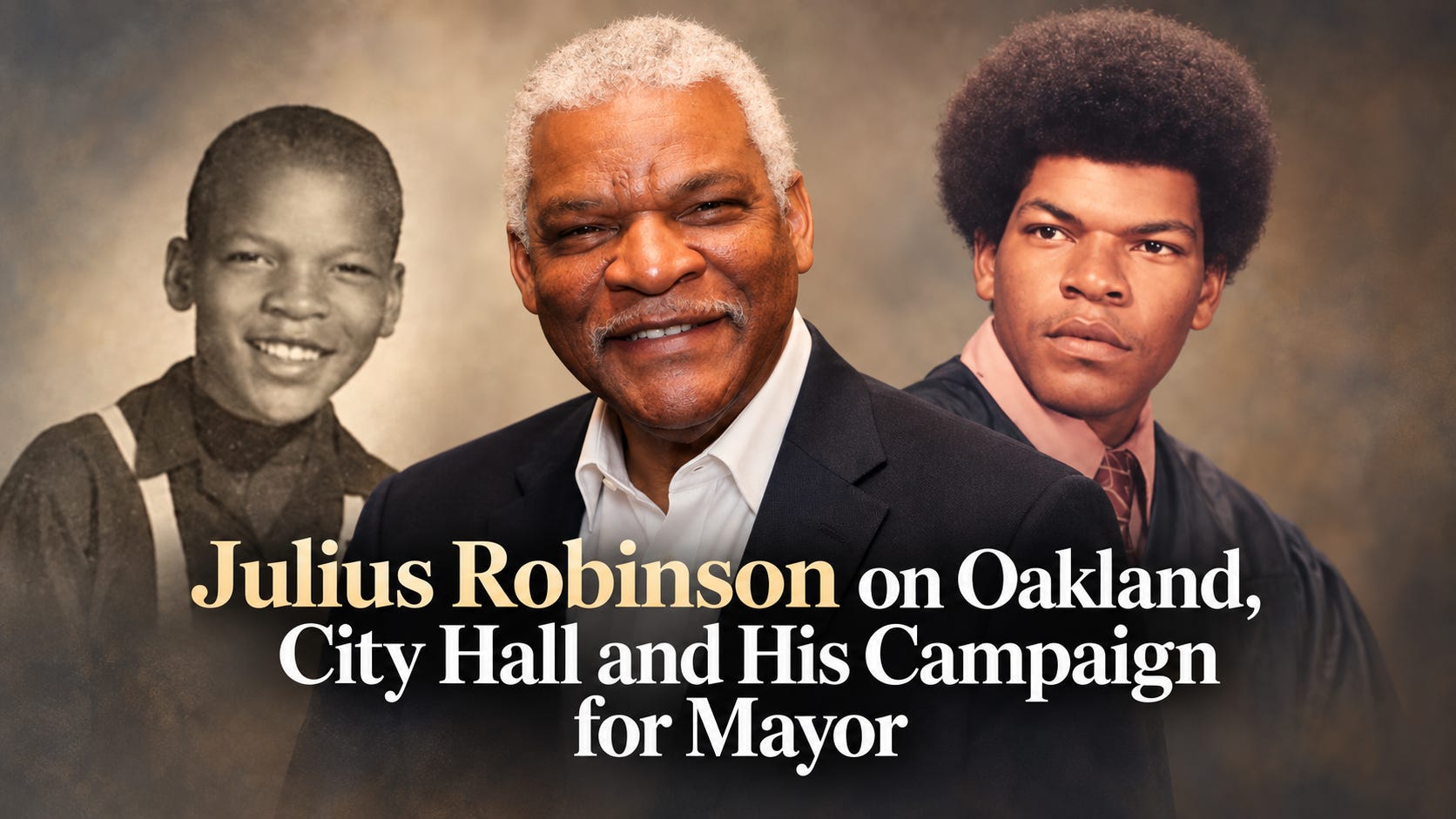
Julius Robinson is running for mayor of Oakland in the Nov. 3, 2026 election. His campaign biography traces his story to Watts, California, and says those early experiences shaped his understanding of resilience, responsibility and leadership. Oakland’s final qualified-candidate list includes Robinson in the mayoral race.
Robinson’s campaign presents his professional and civic background as part of the case for his candidacy. The written responses he provided offer a fuller view of that case than campaign slogans alone, combining personal history with his description of the kind of mayor he would try to be.
Citeline invited Robinson to discuss his background, his priorities and how he would approach governing Oakland. Rather than summarize those positions for readers, Citeline is presenting the written responses it received from Robinson and his campaign.
Editor’s note
Citeline submitted written questions to Julius Robinson and received his responses directly from him.
Much of the response is written in the third person. Citeline identifies those passages as responses from the Robinson campaign. Clear first-person passages are attributed directly to Robinson and placed in quotation marks.
Slide titles and decorative presentation headings have been omitted for readability. Functional labels are retained where needed to preserve the meaning or organization of an answer. Citeline also expanded surname-only references to the full names Sid Castillo and Steve Glazer, as identified in Robinson’s source document. The answer text is otherwise reproduced without alteration.
The views, policy positions and factual claims in the responses are those of Robinson and his campaign. Publication does not constitute an endorsement by Citeline.
Source document
Citeline is publishing the written response used for this interview alongside the article. The source document has not been altered.

The Interview
Robinson and his campaign discuss the experiences, priorities and governing choices behind his run for Oakland mayor.
Citeline: Of everything you have accomplished during your career in banking, community development and nonprofit work, what are you most proud of and why?
Robinson campaign: Of everything Robinson has accomplished across four decades in banking, community development, and nonprofit leadership, he returns most readily to one chapter: the pandemic.
Robinson directed his group to harness the company’s financial resources and collective energy to make tangible commitments to communities hit hardest by the crisis — acting with urgency when it mattered most.
He focused especially on small businesses in downtown Oakland and across the city that had been shut out of federal relief programs. His group supported the Paycheck Protection Program and worked to ensure capital reached small businesses — not larger corporations. He also directed resources away from large national institutions and toward community-based nonprofits facing serious funding shortfalls.
Citeline: What made Oakland the place where you wanted to put down roots, and what do you personally love most about the city?
Robinson campaign: The Bay Area initially drew Robinson through his career in banking and finance. San Francisco’s Financial District was then the financial capital of the West Coast — the place to build a serious career in the industry.
But once he arrived, Oakland captured him — its vibrancy, cultural richness, diversity, and the sophistication and authenticity of its people. Oakland offered something deeper than professional opportunity: a place to build a life, become part of a community, and raise a family.
Robinson: “Nearly 40 years later, that decision — and my affection for this city — remain as strong as ever.”
Citeline: Which person, whether someone from your own life or an Oaklander past or present, has most shaped your understanding of leadership, and what did you learn from that person?
Robinson campaign: Two mentors, in particular, shaped Robinson’s understanding of leadership.
Sid Castillo mentored Robinson as a teenager at Rockwell International, a NASA Space Shuttle contractor. He instilled confidence Robinson didn’t yet possess and taught him that success carries a responsibility to bring others along.
Steve Glazer became both mentor and sponsor during a major bank reorganization, opening doors at the executive level. Robinson learned that leadership means advocating for people and helping them become leaders themselves.
Citeline: Outside of work, meetings and public life, what do you most enjoy doing that Oaklanders might be surprised to learn about?
Robinson campaign: Robinson served on the board of the Museum of the African Diaspora and helped develop a collaboration with SFJAZZ — where he now serves on the board. That partnership brought music and art together in a series that introduced new audiences to both organizations. He enjoys music of virtually every genre.
He grew up attending Lakers games with his father, later continued that tradition with his two sons, and became a Warriors season-ticket holder after making Oakland home — a commitment he has maintained for more than a decade.
For Robinson, the arts and basketball represent something larger: family, culture, community, and experiences shared across generations. He believes deeply in the power of arts and culture to connect people and expand our understanding of one another.
Citeline: If you had a few minutes to introduce yourself to an Oakland resident who knew nothing about your career or campaign, what would you want that person to understand about you?
Robinson: “I am a thoughtful, pragmatic leader who has spent more than four decades bringing people, institutions, and capital together to solve difficult problems.”
Robinson campaign: For the last 15 years of his banking career, Robinson led corporate social responsibility for MUFG Union Bank across the Americas — responsible for ensuring that the bank’s capital, products, and services reached low- and moderate-income communities. His portfolio included financing affordable housing, expanding homeownership access, supporting small businesses, strengthening supplier diversity, and directing more than $350 million into investment funds that helped businesses grow, create jobs, and generate economic opportunity.
Robinson chaired the bank’s foundation and established its environmental, social, and governance program. His focus was never simply on meeting regulatory requirements — it was on using institutional resources responsibly and delivering measurable results. He describes his style as confident but collaborative: listening carefully, seeking common ground, but prepared to make difficult decisions and accept responsibility for the outcome.
Citeline: What are the first three fiscal decisions you would make as mayor to address what you believe is structurally wrong with Oakland’s finances?
Robinson campaign: Asked what he would do first as mayor to address Oakland’s structural fiscal problems, Robinson laid out three concrete priorities.
Performance-based budgeting with measurable departmental results. Every department identifies essential services, vacancies, contracts, and outcomes. Temporary revenues stop funding permanent expenses.
Restore civilian positions — dispatchers, evidence technicians, crime analysts, records specialists — so sworn officers stop performing work civilians can handle more effectively. Invest selectively in technology that improves response, investigations, and accountability.
Streamline permitting, strengthen business corridors, and bring capital to Oakland businesses through banks, the SBA, and community lenders. Revitalize areas like Jack London Square. Collect taxes, fees, fines, and citations already owed — including those tied to illegal dumping.
Citeline: What would your proposed 100-day fiscal-transparency plan give Oakland residents that the City Auditor and the city’s existing financial-reporting systems do not already provide?
Robinson campaign: Robinson’s plan connects spending to services to results — and makes that connection visible to every resident.
Publish an honest baseline: recurring revenues and expenses, structural deficit, departmental spending, overtime, vacancies, major contracts, reserves, debt, and long-term pension obligations.
Each major department publishes a limited set of understandable performance measures, defined priorities, and a named official accountable for delivering results.
Launch a public accountability dashboard: what was promised, what was spent, what was accomplished, and where corrective action is required — including tracking of City Auditor recommendations.
Transparency should identify problems early — not just explain what went wrong after the fact.
Citeline: What level of police staffing do you believe Oakland can responsibly afford while still funding the other services the city needs?
Robinson campaign: Robinson supports at least 700 sworn officers — the Measure NN benchmark — while preserving civilian positions: dispatchers, evidence technicians, crime analysts and investigators. Staffing evaluated against response times, overtime costs, case-clearance rates and residents’ experience of safety.
Citeline: What policy would you set for Oakland’s use of Flock and other automated license-plate-reader systems, including the uses or data sharing you believe should be prohibited? Oakland’s Inspector General reviewed OPD’s ALPR policy in July and identified privacy and civil-liberties concerns as legitimate issues for city policy.
Robinson campaign: Supports ALPRs as focused investigative tools with strict safeguards. Prohibited uses: monitoring protests, immigration enforcement, reproductive-health investigations, race-based profiling. Data deleted after the shortest practical retention period. Regular public reporting required.
Citeline: What evidence should determine whether Oakland puts its next public-safety dollar into traditional policing or into violence-prevention and intervention programs?
Robinson campaign:
Traditional Policing
Metrics to examine:
911 response times
Patrol coverage
Overtime costs
Investigative capacity
Violent-crime clearance rates
Violence Prevention & Intervention
Metrics to examine:
Whether programs reach those at greatest risk
Reduction in shootings and retaliation
Connection of participants to stabilizing services
The next dollar should go where the evidence shows it will prevent the most harm and close the most urgent service gap. Success is measured by fewer shootings, faster emergency response, more crimes solved, and residents feeling safer — not simply by officers hired, arrests made, or grants awarded.
Citeline: Oakland currently bars its police department from assisting ICE with civil immigration enforcement except under specified circumstances. Would you keep that policy as it stands, strengthen it or change it? Why?
Robinson campaign: Robinson would keep Oakland’s sanctuary policy and strengthen its enforcement and accountability provisions.
When residents fear that contacting police could expose them or their families to immigration action, victims and witnesses are less likely to report crimes or cooperate with investigations — making the entire city less safe. Oakland police officers should focus their limited resources on preventing and solving crimes, not carrying out federal civil immigration enforcement.
Sanctuary policy is not about ignoring the law — it is about ensuring that every Oakland resident, regardless of immigration status, can call for help, report a crime, and cooperate with police without fear. That trust is essential to public safety.
Citeline: Oakland continues to tax and regulate legal cannabis businesses while operating programs intended to support cannabis equity and local employment. Do you believe the city has struck the right balance between collecting cannabis revenue and maintaining a viable legal cannabis industry? If not, what would you change?
Robinson campaign: Robinson believes Oakland’s approach to cannabis is out of balance. Legal businesses face taxes, fees, and illegal-market competition that make long-term viability precarious. He would review cannabis taxes against neighboring jurisdictions, streamline permitting, and evaluate whether the equity program is producing viable businesses — not simply issuing licenses. The goal: a regulated industry that employs Oaklanders and contributes sustainable revenue.
Cannabis cultivation and manufacturing have occupied industrial and warehouse spaces historically home to Oakland’s artists and creative businesses. Robinson would develop a zoning strategy that identifies appropriate cannabis locations while preserving affordable production, rehearsal, and studio space — including incentives for shared facilities and community-benefit agreements.
Citeline: What do you believe the American political left and political right each misunderstand about governing cities like Oakland?
Robinson campaign: The left sometimes treats government programs as inherently valuable regardless of whether they produce measurable results. Oakland residents want competent execution, not simply more spending. Programs that cannot demonstrate outcomes should be reformed or eliminated — even when they have committed constituencies.
The right sometimes assumes that reducing government is the solution to every problem. Oakland’s challenges — public safety, housing, homelessness — require active, well-managed government. The answer is not less government, but government that works: disciplined, accountable, and focused on results.
Robinson: “What I hear consistently from Oakland residents is less ideological. They want safe and clean neighborhoods, responsible financial management, housing they can afford, thriving businesses, and leaders who are accountable for results. My approach is to take workable ideas from wherever they come and judge them by whether they measurably improve people’s lives.”
Citeline: What role should artificial intelligence play in Oakland city government over the next decade? Where should the city draw a firm boundary on its use?
Robinson campaign: Forecast revenues and service demands, identify emerging problems, strengthen financial forecasting, and monitor departmental performance.
Improve permitting and plan review, make it easier for residents to obtain information and navigate city services, and identify patterns in illegal dumping and infrastructure failures.
AI should enhance the productivity and judgment of city employees — not simply eliminate positions or replace human expertise.
AI should never make final decisions affecting a person’s rights, employment, access to public benefits, housing, or treatment by law enforcement.
AI is a tool — a powerful one — but the decisions that affect people’s lives must remain in human hands, subject to human accountability.
Citeline: When Oakland uses public resources to attract a major employer, what should the city require from that company in return?
Robinson campaign:
Specific, enforceable commitments to create quality jobs, hire and train Oakland residents, and move them into well-paying careers.
Contract with local and minority-owned businesses, contributing to the economic vitality of the surrounding neighborhood.
Depending on the project: investments in transit, public spaces, neighborhood beautification, affordable commercial space, and partnerships with Oakland’s arts and cultural community.
Commitments must be proportional to the public support provided and tailored to the company’s business model. We should not impose unrelated obligations that make the investment unworkable.
Public investment must produce public value — not simply enhance a corporation’s bottom line. Oakland should welcome major employers and help them succeed, but the community must share in that success.
Citeline: Who should control your proposed Oakland Opportunity Fund, and what accountability structure would protect it from favoritism, political influence or losses being shifted onto taxpayers?
Robinson campaign:
Governance Structure
Professionally managed under clear investment and public-benefit standards adopted by the City Council
Neither the mayor nor individual councilmembers should select recipients or direct individual investments
An independent community advisory board provides oversight, with members including residents, small-business owners, community-development professionals, and finance/housing/workforce experts
Members serve staggered terms with strict financial-disclosure, conflict-of-interest, and recusal requirements
Accountability & Transparency
City Auditor independently audits the fund and reports publicly on finances, performance, and internal controls
Every investment evaluated through published eligibility and underwriting standards with documented scoring
Public dashboard showing recipients, amounts committed, intended outcomes, actual results, and underperforming investments
Taxpayer exposure limited through defined risk caps, reserves, portfolio diversification, and private-sector participation
Pilot Fund Structure: $25M total fund | $5M initial City contribution | Outside matching capital required | Performance-based funding stages | No automatic General Fund bailout
Citeline: Your campaign says you helped deploy more than $37 billion in capital and helped create a $350 million SBIC investment pool. How should voters understand those figures in terms of your own decision-making authority and the measurable results you personally helped produce?
Robinson campaign: Managed directly through Robinson’s office, along with $85 million in philanthropic investments. He identified opportunities, evaluated fund managers and directed capital toward businesses capable of creating jobs and strengthening communities.
A multiyear commitment negotiated and administered by his group across the bank’s footprint. Robinson established the strategy, coordinated execution and reported progress to executive management, the board and the OCC. Commitments included affordable mortgages, small-business lending, affordable housing and down-payment assistance.
The measurable result: the bank met or exceeded its program goals while expanding access to homeownership, affordable housing, and capital for communities that had historically been underserved.
Citeline: How would you expand access to Oakland contracts and business opportunities without simply replacing one group of well-connected insiders with another?
Robinson: “Drawing on banking experience with supplier diversity and CDFIs, I would apply the following in Oakland:”
Robinson campaign:
Publishing a forward-looking schedule of contracting opportunities.
Simplifying applications and dividing large contracts into smaller components when practical.
Using clear, publicly available qualification and scoring criteria.
Expanding outreach through supplier-diversity councils, chambers of commerce and community business organizations.
Providing technical assistance on bidding, compliance and contract performance.
Connecting businesses with CDFIs, bonding companies and insurance providers.
Publicly reporting contract awards, subcontracting commitments and contractor performance.
Strong conflict-of-interest requirements, independent review and regular audits to ensure contracts are awarded on merit rather than political relationships.
Citeline: What single change to Oakland’s housing or development system do you believe would produce the greatest increase in housing without worsening displacement?
Robinson campaign:
Set firm decision timelines
Run departmental reviews concurrently
Expand online application & tracking
Use technology to catch conflicts early
Expedite review for affordable housing & transit-adjacent infill
Supply alone won’t prevent displacement. Reform must pair with:
Tenant protections
Affordable-housing requirements
Programs that help existing residents remain in their homes
Build faster, reduce costs, protect existing residents.
Citeline: When an encampment creates serious health, safety or access problems and an unhoused resident declines available shelter or services, what should the City of Oakland do?
Robinson campaign: Oakland has outreach, shelter, behavioral-health and enforcement resources — but responsibility is split among City departments, Alameda County and service providers, with no single point of accountability.
Robinson: “I would establish one coordinating structure, a shared by-name case-management system and clear responsibility for every priority encampment — tracking who was contacted, what was offered, why it was declined and what comes next.”
Robinson campaign: Outreach must continue and placements must actually fit the person’s needs. But when an appropriate alternative exists, Oakland must enforce reasonable health, safety and public-access standards.
Success should be measured by durable housing placements — not simply by encampments cleared.
Citeline: When should an Oakland mayor be willing to tell a city employee union that the city cannot afford what it is asking for? What should the city reasonably expect from its employees in return for compensation and contract terms that Oakland can sustainably afford?
Robinson campaign: A mayor must say no when independent projections show a contract cannot be sustained without deeper deficits or layoffs — but only after transparent analysis and good-faith bargaining. Agreeing to unsustainable compensation ultimately puts jobs, services and fiscal stability at risk.
Oakland should expect employees at every level—including senior management—to:
Provide reliable, responsive and professional service
Meet clear performance standards
Use public resources responsibly
Participate constructively in efforts to modernize operations and improve productivity
Labor and management must negotiate as partners — agreements should respect the workforce, protect services and remain affordable for the life of the contract.
Citeline: What disclosure or recusal standard would you apply to yourself when a former colleague, professional partner or organization from your business network seeks a contract, approval or other action from the city?
Robinson campaign: Disclose the relationship in writing and seek guidance from the City Attorney or Public Ethics Commission before any action is taken.
Step back from developing the solicitation, evaluating proposals or approving the award. Any sole-source contract requires written justification, independent approval and public disclosure.
Former colleagues may compete for City business — but receive no special access or advantage. Decisions must use published criteria, documented scoring and independent review.
Professional relationships may help identify capable candidates; they must never determine who receives a City contract or favorable action.
Citeline: Which governing structure do you believe would serve Oakland best: its current arrangement, a stronger-mayor system or a council-manager model? Why?
Robinson campaign: Oakland would be best served by a stronger-mayor system approved by voters through charter reform. The mayor should have clear executive authority to manage operations, appoint accountable leadership and hold a carefully defined line-item veto subject to Council override.
The current structure disperses authority among the mayor, City Council and City Administrator. When responsibility is too broadly divided, decisions slow and residents can’t tell who is accountable.
The Council must retain its legislative, budgetary and oversight responsibilities. Independent fiscal analysis, the City Auditor and the Public Ethics Commission remain essential checks.
Oakland needs clearer responsibility and stronger checks — not authority without accountability, or accountability without authority.
Citeline: If your approach to governing succeeds, what should be measurably different about Oakland in 2036?
Robinson campaign: Structurally balanced budgets, responsibly funded reserves, and transparent public reporting that every resident can understand and trust.
Violent crime and emergency-response times substantially lower. Unsheltered homelessness significantly reduced, with fewer people returning to the streets after receiving assistance.
Permitting decisions taking months, not years. Housing production accelerating while tenant protections keep existing residents in place.
Active business corridors, greater access to City contracts and capital, more locally owned businesses, and Oakland residents moving into well-paying jobs.
By 2036, Oakland should be known not for its potential alone — but as a model of accountable government and inclusive growth.
Citeline analysis: What Robinson’s answers suggest about how he would lead
The analysis below is Citeline’s interpretation of the written responses provided by Robinson and his campaign. It is neither an endorsement nor an argument against his candidacy.
Taken together, Robinson’s answers describe a management-oriented approach to the mayor’s office. The same ideas recur across different subjects: establish measurable goals, identify who is responsible, publish enough information for outsiders to judge performance and build review mechanisms around decisions involving public money or authority. Fiscal dashboards, police response times, contract scoring, audits, employee standards and investment reporting all fit that pattern.
His preference for a stronger mayor adds another part to that model. Robinson argues for clearer executive authority while preserving legislative, budgetary and oversight responsibilities for the City Council and independent roles for the City Auditor and Public Ethics Commission. That would shift the structure of accountability rather than simply change management practices.
The proposal also sits inside an active Oakland debate. The city currently has a mayor-council government in which the mayor oversees the executive branch and appoints the City Administrator, subject to council confirmation, while the administrator manages day-to-day administrative and fiscal operations. Oakland’s 2026 charter-reform process has separately advanced a strong-mayor, strong-council model intended to create clearer executive responsibility while strengthening council oversight. Robinson’s proposal and the city reform discussion overlap in broad direction, although they should not be treated as identical without comparing the specific charter language.
The newer answers add detail to how Robinson says he would constrain discretionary power. His Opportunity Fund proposal would keep individual investment decisions away from the mayor and councilmembers, use published underwriting standards and documented scoring, subject the fund to City Auditor review and impose risk controls on taxpayer exposure. His AI answer follows a similar pattern: use technology to improve analysis and services, but keep final decisions affecting rights, employment, public benefits, housing and law enforcement in human hands.
His answer about the political left and right also helps clarify the philosophy behind that emphasis on measurement. Robinson criticizes the left when, in his telling, programs are defended without evidence of results, and the right when smaller government is treated as an answer in itself. He describes his own approach as taking workable ideas from different sources and judging them by measurable effects. That is Robinson’s characterization of his politics, not an independent ideological classification by Citeline.
The same approach appears in his treatment of private investment. When public resources are used to attract an employer, Robinson calls for enforceable commitments tied to jobs, local contracting and community investment, while also saying those requirements should be proportional to the public support offered. His Opportunity Fund proposal similarly combines a city contribution with outside matching capital and says there should be no automatic General Fund bailout. The common feature is an effort to attach rules and public-benefit conditions to the use of public leverage.
There are limits to what a written questionnaire can establish. The responses show how Robinson says he would organize decision-making, but they cannot establish how those systems would perform in practice, what every proposal would cost or how he would act when two legitimate objectives point in different directions. His large career figures, including the $37 billion community commitment and $350 million investment portfolio, also remain campaign assertions unless supported through separate records. CiteLine’s interview standards treat participant assertions as claims that may require independent verification rather than as facts merely because they were supplied on the record.
The clearest inference concerns the architecture of leadership Robinson is proposing. He describes a mayoralty with stronger executive responsibility, extensive use of performance measures and formal limits on individual discretion. He also repeatedly places audits, disclosure, published criteria or outside review around areas where money or authority could otherwise be exercised informally. Whether that structure would produce the outcomes his campaign describes is a separate question. The questionnaire provides evidence of the governing model he is proposing, not evidence of how successful that model would be.
Sources
https://www.julius4mayor.com/about
https://www.julius4mayor.com/vision
https://www.oaklandca.gov/Government/Elections
https://www.oaklandca.gov/Government
https://www.oaklandca.gov/Government/Departments/City-Administrator
https://www.oaklandca.gov/Government/Departments/Inspector-General/OIG-Published-Reports