

When the State Turned on Union Workers and Their Families
The Ludlow, Colorado Massacre of 1914

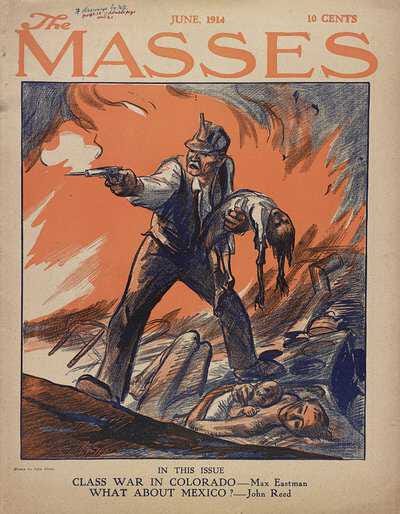
I came to Ludlow while researching a recent article on the 1946 general strike in Oakland, California. That reporting led me backward into earlier episodes of labor conflict and state repression, and in that research I encountered one of the darkest chapters in American labor history.
What I found was not a historical footnote. It was a case that forced a broader question about labor, power, and the use of state force in industrial conflict. The record at Ludlow is severe enough that it cannot be dismissed as a mere episode of unrest.
This editorial argues that Ludlow should be understood as a failure of public order and democratic obligation rather than as a misunderstanding produced by a chaotic strike.
The verified factual foundation
By 1913 and 1914, southern Colorado coal miners were striking over wages, safety, representation, and control over basic conditions of life in company towns. In much of the coalfield, housing was not separate from employment. Mining companies owned the homes, the land around them, and many of the institutions that structured daily life. A miner who lost his job or joined a strike did not merely lose wages. He and his family could also lose their home, access to company stores, and the limited security that came with remaining inside the company town.
That arrangement gave employers a powerful weapon at the outset of the strike. Once miners walked out, evictions followed. Families were pushed out of company housing and forced to leave communities in which work, shelter, and local authority had been tightly bound together. The expulsion was therefore not incidental to the labor dispute. It was part of the structure of control that made the strike so consequential.
In response, many miners and their families moved into tent colonies established by the union as emergency communities outside company control, often on land leased for that purpose. Those camps were not temporary symbols alone. They were living spaces where displaced families slept, cooked, organized, and tried to preserve some measure of stability while the strike continued. Ludlow became the best known of those camps, both because of its size and because it would become the site of the most infamous violence in the Colorado coalfield war.
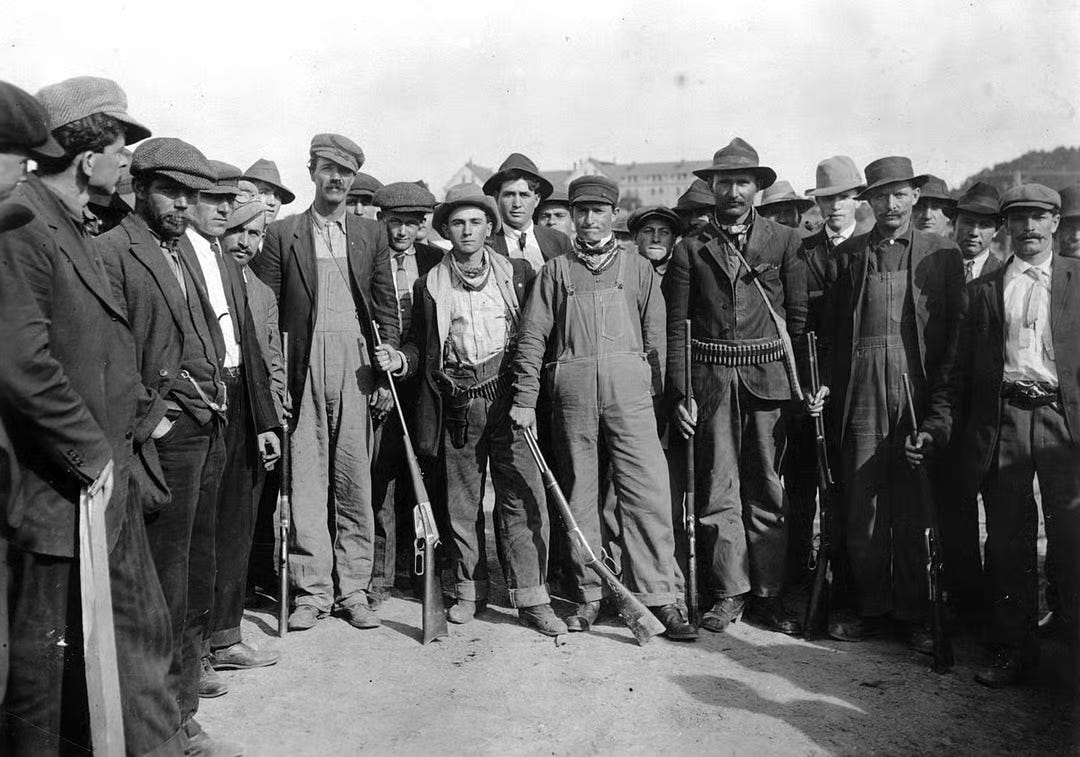
The conflict was already violent before the attack. That context is necessary for accuracy. Strikers were armed. The coalfield war had produced shootings, raids, intimidation, and fear on multiple sides. The situation was unstable, bitter, and coercive.
On the miners’ side, several names should remain visible rather than absorbed into abstraction. Louis Tikas was the best known local organizer at Ludlow and the leader of the Greek miners in the colony. He was killed on the day of the attack and became one of the central symbols of the massacre. John R. Lawson stood among the principal strike leaders in Colorado. After the strike, he was prosecuted, convicted of murder, and sentenced to life at hard labor before the Colorado Supreme Court overturned that conviction in 1917. James Fyler was one of the dead at Ludlow and remains part of the human record of who was there and who paid with his life.
The dominant corporate power in this conflict was the Rockefeller-owned Colorado Fuel and Iron Company. The names most closely tied to that side of the struggle were the Rockefeller family, especially John D. Rockefeller Jr., the son of Standard Oil founder John D. Rockefeller and the heir who oversaw major portions of the family’s industrial wealth, the company’s majority shareholder, and CF&I vice president Lamont Montgomery Bowers, who took a leading role in the company’s anti-union position. After Ludlow, Rockefeller faced national outrage, congressional scrutiny, and long-term reputational damage, but not criminal punishment. Bowers remained a central company figure in the years after the massacre.
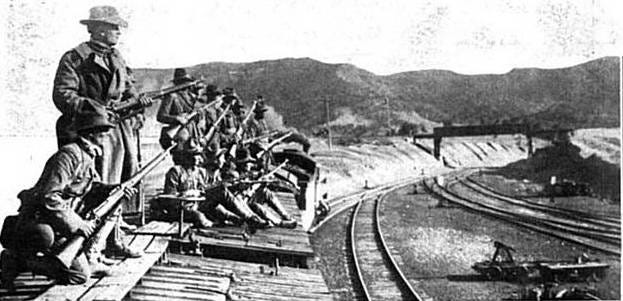
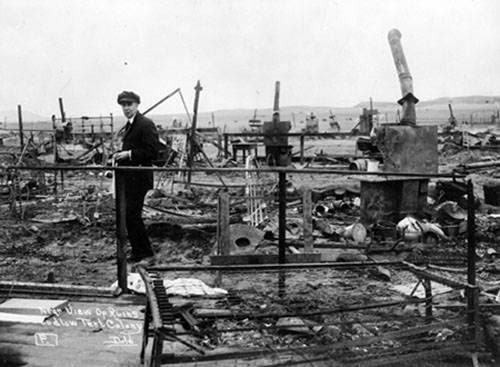
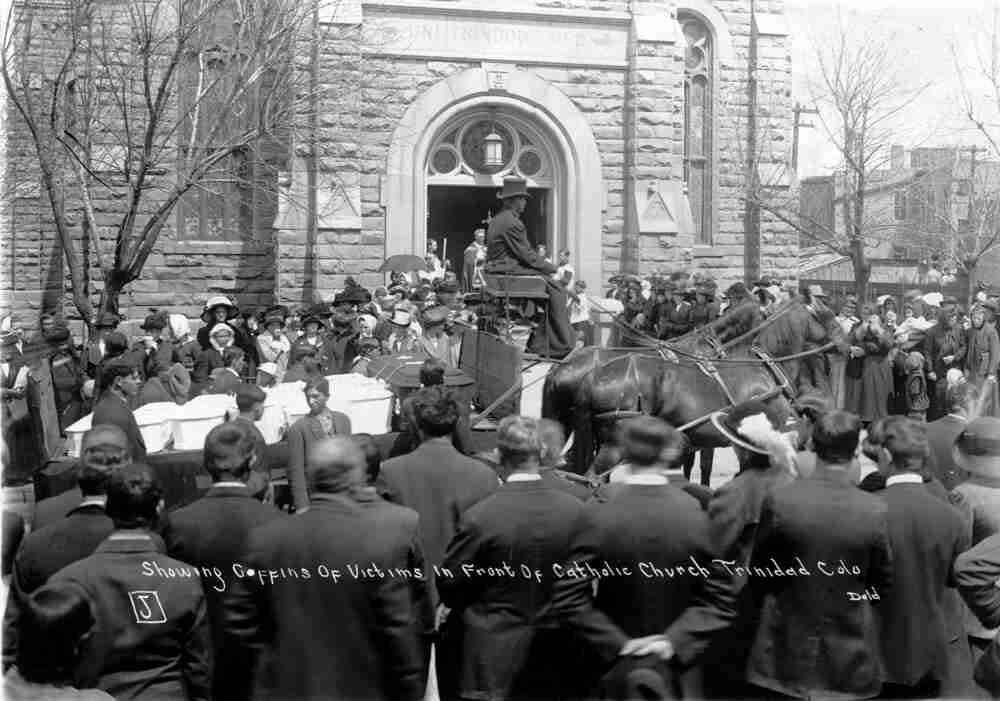
That context does not alter the core sequence on April 20, 1914. National Guardsmen aligned with the Colorado Fuel and Iron Company attacked the Ludlow tent colony. The tents burned. Men, women, and children were murdered. A current federal historical summary gives a death toll of 21, including 11 children. Other historical accounts report somewhat higher totals. That discrepancy is important for precision and belongs in any careful retelling. It does not alter the central point, though. Families living in a strike camp came under attack from armed state-sponsored militia forces operating in alignment with the power of the company they were resisting.
These facts support a clear lack of moral judgment.
The militia chain of command should also be named plainly. General John Chase commanded the broader Colorado militia apparatus. Major Patrick J. Hamrock and Lieutenant Karl E. Linderfelt were among the officers most directly associated with the Ludlow operation and its aftermath.
The aftermath for those officers was uneven in ways that matter to the historical judgment. Chase faced criticism and inquiry, but he was not court-martialed for Ludlow. Hamrock remained in the Colorado National Guard after the strike and later served as Colorado’s adjutant general. Linderfelt was found guilty of assaulting Louis Tikas, yet the penalty amounted to a light reprimand rather than serious punishment. The larger pattern is difficult to ignore. The miners and their families absorbed the killing, displacement, and prosecutions, while the principal officers associated with the attack largely escaped meaningful consequences.
What Ludlow indicates about power
The historical record of Ludlow places a basic question at the center of democratic life. When conflict sharpens between wealth and labor, which interests receive the protection of the state?
In theory, the state is supposed to protect public order for everyone. It is supposed to stand above private factions, enforce rules consistently, and guard civilian life. In practice, the Ludlow record demonstrates how limited that neutrality can become when one side owns the houses, controls the jobs, shapes the local economy, and can influence the forces sent to restore order.
The miners at Ludlow were not merely contesting pay levels. They were resisting a system of dependency. Company control extended beyond the mine entrance into housing, medical care, commerce, and daily survival. Under those conditions, a strike was not merely a work stoppage. It was a demand for treatment as human beings with rights that did not end at the edge of company property.
The attack on a tent colony is significant for that reason. The colony was not a remote battlefield occupied only by armed men. It was a site where families slept, cooked, raised children, and attempted to survive after displacement. Any state action directed at such a site carried a clear obligation of restraint and civilian protection. The outcome at Ludlow establishes that this obligation was not met.
Once children die in concealment beneath burning tents, the language of neutral order no longer carries much force. At that point, the relevant issue is not simply whether officials claimed to be restoring peace. The relevant issue is the distribution of protection, exposure, and loss.
Why euphemism fails here
American historical writing often relies on abstract language when violence serves property and hierarchy. The event is described as a clash, a confrontation, a breakdown, an eruption, or a tragedy. Some descriptive value exists in those terms. They can also obscure agency.
Ludlow was tragic, but tragedy is not a substitute for description. It was a confrontation, but that term is too bloodless if it conceals who held public authority, who lived in the colony, and who died there. It was a breakdown, but that term suggests symmetry. The documentary record supports something more specific and more disturbing. State-backed force, in practical alignment with company power, was used against a strike camp filled with workers’ families.
No exaggeration, fantasy, or myth is required. Plain description is sufficient.
If a government force operates in alignment with a corporation during a labor struggle, claims of neutrality require scrutiny. If families are dead after an assault on a tent colony, official language about order requires skepticism. If the dead include children, any effort to reduce the event to a regrettable side effect of unrest amounts to evasion rather than analysis.
The strongest counterargument
The strongest counterargument should be stated fairly.
A defender of the state response might argue that the broader coalfield conflict had already become violent, that armed strikers and armed guards were engaged in a dangerous struggle, and that officials faced a real public-order crisis. Under that interpretation, Ludlow was not a simple crushing of peaceful innocents. It was a chaotic battle within a wider conflict in which officials, however imperfectly, were attempting to prevent broader collapse.
That argument has some factual basis. The coalfield war was not a one-sided tableau of passive victims and unprovoked shooters. There had been prior violence. There were weapons in the colony. There was fear on multiple sides. A serious editorial should include that context.
The counterargument is still unpersuasive.
The relevant standard is not whether the strikers were flawless. The relevant standard is whether the state met its obligation to remain independent from private power and to protect civilian life. The Ludlow record indicates that it did not.
The presence of armed tension does not excuse alignment between public uniforms and company interests.
A state cannot credibly claim democratic legitimacy if, during a labor conflict, workers encounter public force as an extension of the company they are fighting.
The dead children at Ludlow are not incidental to the judgment. Their deaths are central evidence of what this system permitted.
Why the lesson is larger than one massacre
The significance of Ludlow lies in the fact that it was not merely a local horror. The event brought into public view a structure that often remains less visible until extreme violence makes it unmistakable.
That structure has several parts.
First, concentrated private power can shape the lived conditions of workers far beyond wages.
Second, once conflict escalates, the language of law and order can be used to dignify outcomes that mainly preserve the hierarchy that produced the conflict.
Third, when the state becomes entangled with corporate interests, even formally public action can become substantively partial.
Fourth, public outrage after a massacre can produce reform, but reform does not erase the underlying warning.
Ludlow helped intensify national scrutiny of labor conditions, industrial violence, and the legitimacy crisis created when workers were treated as disposable. The deeper lesson is not that progress automatically follows atrocity. The deeper lesson is institutional. Democratic systems require safeguards against capture before violence becomes the mechanism of decision.
A society does not become just because public embarrassment follows the deaths of children. Greater justice requires institutions that reduce the likelihood of such deaths in the first place.
The judgment
The judgment should therefore be stated plainly.
The Ludlow Massacre was a disgrace, not only for the company whose interests framed the conflict, but also for the public order that failed to separate itself from those interests. It was a collapse of civic obligation. The event demonstrated the consequences that follow when workers demanding dignity confront a system more prepared to defend property, hierarchy, and industrial control than human life.
Accurate remembrance of Ludlow requires resistance to two temptations at once.
The first is sentimental simplification. Historical events are rarely tidy, and Ludlow occurred within a violent labor war. That context should remain visible.
The second is sanitizing language that converts power into abstraction. The historical record is plain enough. Public force aligned with private power attacked a tent colony of strikers and their families. Children died. Any interpretation that cannot state those facts directly is not more balanced. It is less honest.
The historical record of Ludlow puts a continuing question into public view. When working people challenge concentrated power, will the institutions of the state protect equal citizenship, or will those institutions function as a harder shell around wealth
An exact repetition of Ludlow on the same terms would be unlikely in modern labor politics. The company-town order that structured this conflict no longer exists in the same form, and an open armed assault on a strike colony would face immediate legal, political, and public scrutiny. Even so, improbability should not be confused with impossibility. In 2025, a federal judge ruled that the Trump administration had broken the law by using National Guard troops and Marines in Los Angeles during protests tied to ICE raids, though parts of that litigation were later stayed during appeal before the deployment ended at the close of the year. That episode was not Ludlow. Its relevance lies in the warning it provides. Executive power can still push military or quasi-military force into domestic political conflict under the language of order, emergency, and enforcement.
At Ludlow, the answer took the form of fire.
Sources
War in the Coalfields The Ludlow Massacre and its Impact on the Eight-hour workday https://www.nps.gov/articles/000/war-in-the-coalfields-the-ludlow-massacre-and-its-impact-on-the-eight-hour-workday.htm
Report on the Colorado strike investigation made under House resolution 387, Sixty-third Congress, third session https://www.loc.gov/item/15026208/
Report on the Colorado strike https://babel.hathitrust.org/cgi/pt?id=mdp.39015031098059&view=1up&seq=5
A Night Letter from Samuel Gompers https://blogs.loc.gov/inside_adams/2020/06/letter-from-samuel-gompers/
American Federation of Labor Records, 1883 to 1925 https://www.loc.gov/collections/american-federation-of-labor-records/
Congressional Record House April 1914 Ludlow material https://www.govinfo.gov/content/pkg/GPO-CRECB-1914-pt7-v51/pdf/GPO-CRECB-1914-pt7-v51-16-2.pdf
Congressional Record Senate April 1914 Ludlow material https://www.govinfo.gov/content/pkg/GPO-CRECB-1914-pt8-v51/pdf/GPO-CRECB-1914-pt8-v51-4.pdf
Lawson v. People https://case-law.vlex.com/vid/lawson-v-people-8730-887011804/
Newsom v. Trump docket https://www.courtlistener.com/docket/70496361/newsom-v-trump/
Order by Judge Charles R. Breyer granting Ex Parte TRO in Newsom v. Trump https://cases.justia.com/federal/district-courts/california/candce/3%3A2025cv04870/450934/64/0.pdf
Ninth Circuit order in Newsom v. Trump https://cdn.ca9.uscourts.gov/datastore/opinions/2025/06/19/25-3727.pdf
Appeals court allows Trump to keep National Guard in L.A. with Marines on the way https://www.reuters.com/world/us/marines-prepare-los-angeles-deployment-protests-spread-across-us-2025-06-12/
US judge blocks Trump from using troops to fight crime in California https://www.reuters.com/legal/government/us-judge-blocks-trump-using-troops-fight-crime-california-2025-09-03/